Asia
Sri Lanka’s Ramayana Trail: When Myth, Money and Hindutva Collide
The Ramayana Trail shows that in today’s South Asia, myth is not a harmless story from the past.

Praveen Kolluguri | On a recent family holiday (December 2025) to Sri Lanka, I unexpectedly found myself in the middle of a live experiment in how mythology can be turned into foreign policy and profit. The itinerary, booked in India, took us through Trincomalee, Kandy, Nuwara Eliya and Colombo. I agreed to join mainly to see my family after a long time apart. Had I been choosing the destination, Sri Lanka’s not-so-distant history of Tamil genocide would have weighed heavily on my decision. Yet the real surprise of the trip was something I hadn’t heard of at all before boarding the plane: Sri Lanka’s Ramayana Trail.
Sold enthusiastically by guides and travel brochures, and promoted by SriLankan Airlines as a way for devotees to “walk in the footsteps of Lord Rama”, the Trail claims to connect dozens of locations on the island to episodes from the Hindu epic.
As someone who views the Ramayana as mythology, not history, the confidence with which these stories were being mapped onto real landscapes felt jarring.
A trail where myth becomes “history”
Our Sinhalese Buddhist guide, a third-generation professional with a tourism degree, set the tone early. Sri Lanka, he reminded us, is a “peaceful Buddhist country”, with around 70% Sinhalese Buddhists, roughly 12–13% Tamil Hindus, and smaller Christian and Muslim minorities. Tourism, he said, is now the backbone of the economy, with Indian tourists making up more than a third of arrivals. Then he casually mentioned that we would be visiting “a few places from the Ramayana Trail”, and that a full version would take at least 15 days. At various points on the journey, Ravana was described to us not as a legendary figure but as a historical king who ruled “around 7,000 years ago”.In Trincomalee, we visited the Koneswaram temple, an important Śaivaite site on a dramatic headland. Here, a large Ravana statue greeted us, and the guide pointed out a split in the rock said to have been cleaved open by Ravana’s sword to impress Shiva.
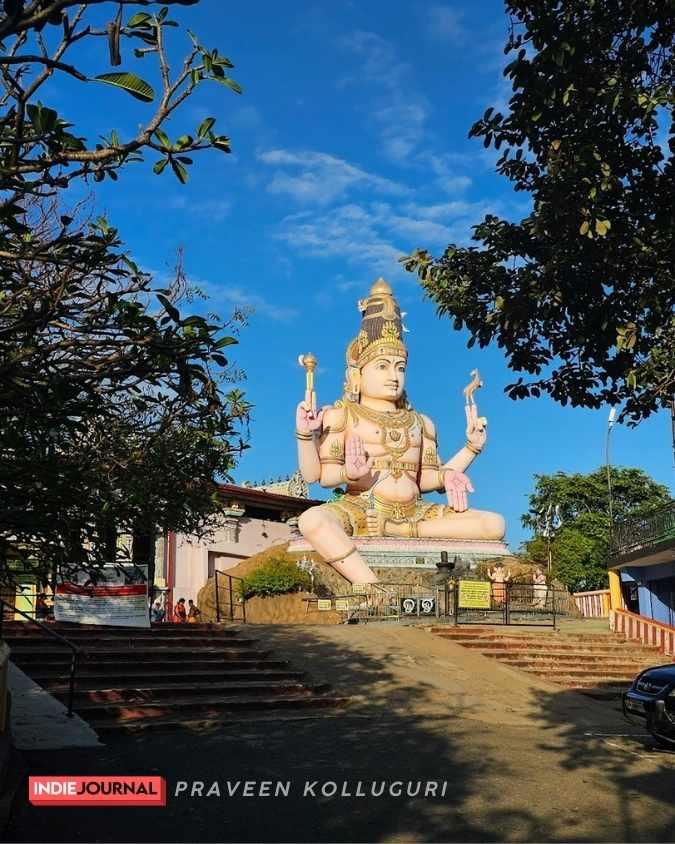 Ravana statue at Koneswaram Temple
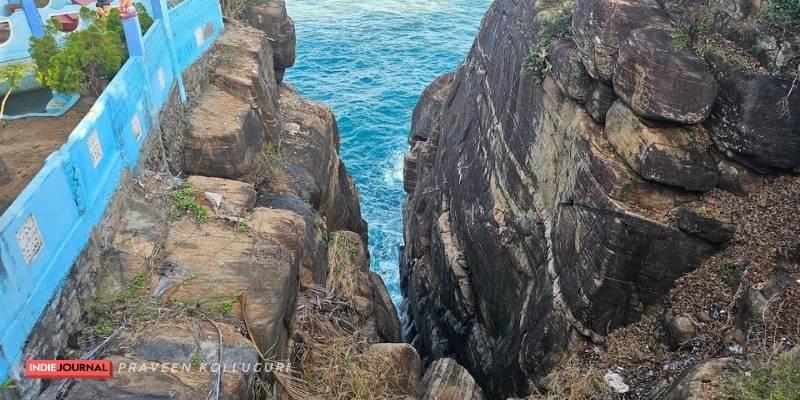 “The cliff cleaved by Ravana's Sword”
The priests were Tamil, the signage included Telugu and Tamil, and the crowd included women in hijab moving through the temple without issue, something that would be impossible in many Hindu temples in India or in the UK. It was a reminder that religious practice in Sri Lanka can be more porous than in the Indian mainland, even as new, more rigid narratives are being imported. Later, in the highlands near Ramboda, we visited a Hanuman temple operated by the Chinmaya Mission. Swami Chinmayananda, the Mission’s founder, was also a co-founder of the Vishwa Hindu Parishad, a central Hindutva organisation implicated in anti-minority mobilisation. The Mission has long been involved in building Hindu cultural networks outside India. Here, in Sri Lanka’s misty hills, they were selling books on Sanatana Dharma while the guide encouraged us to see a vague outline in the mountains as the reclining form of Hanuman. Belief was not just invited but gently enforced through repetition and group enthusiasm.
.jpg "reclining hanuman sri lanka") The outline of mountains resembling a “reclining Hanuman”
The outline of mountains resembling a “reclining Hanuman”
Near Nuwara Eliya, we travelled to the Seetha Amman temple, described to us as one of the only temples in the world dedicated to Sita. This, we were told, was where Sita was held after her abduction by Ravana, and where Hanuman met her and showed her Rama’s ring as proof of his mission. Outside the temple, a depression in rock was labelled as Hanuman’s footprint.
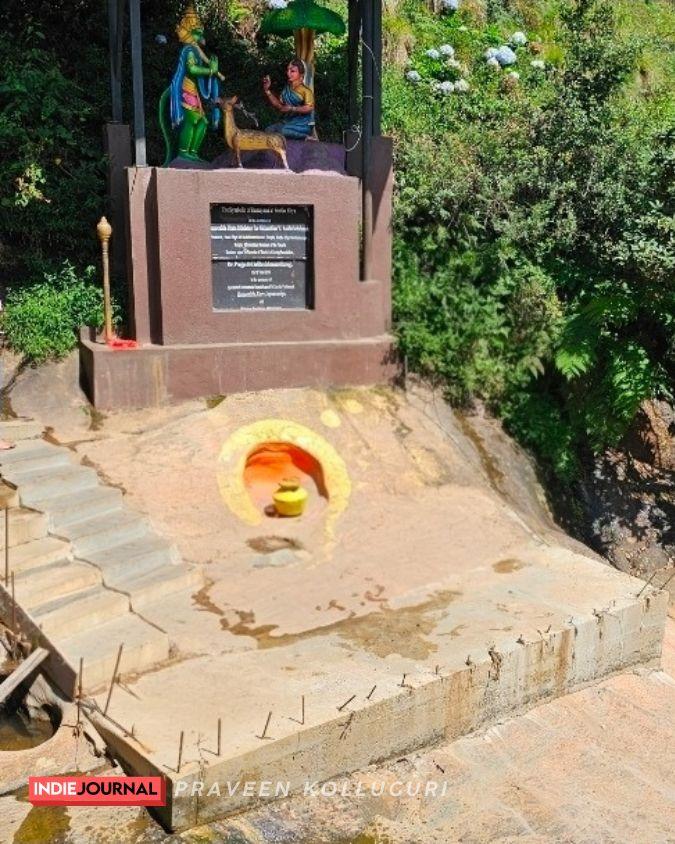 “Hanuman’s footprint” at Seetha Amman Temple, Nuwara Eliya
The temple had recently been refurbished with money from India; boards referenced visits from figures such as Sri Sri Ravi Shankar, another prominent figure in the broader Hindutva ecosystem, and indicated links to the Ayodhya Ram Janmabhoomi Trust, which oversees the Ram temple built on the ruins of the demolished Babri Masjid. The stories only multiplied. Our guide confidently explained that the name “Nuwara Eliya” (“city of light”) came from fires caused when Hanuman’s burning tail set the area ablaze, pointing to dark rocks (naturally occuring) nearby as supposed evidence. At another stop, we were taken to a hillock described as the place where Hanuman dropped a chunk of mountain he had carried from the Himalayas, laden with the life-saving sanjeevani herb for the injured Lakshmana. From there, we were driven directly to a herbal medicine centre selling Sanjeevani inspired miracle oils and potions at £75 a bottle. My more religious family members were delighted. For them, the Trail offered something precious: tangible “proof” that the Ramayana was not just a story but verifiable history. For me, it was deeply unsettling, a form of cosplay with significant ideological stakes.
What archaeologists actually say
What makes this more than just “faith tourism” is that Sri Lankan archaeologists and historians have publicly, systematically and sometimes bluntly demolished the claims underlying the Ramayana Trail. At a 2009 meeting of the Royal Asiatic Society of Sri Lanka (RASSL), scholars (some nationalist) criticised the Sri Lanka Tourism Development Authority’s (SLTDA) Ramayana Trail campaign, questioning whether it was responsible to “promote a fiction for the sake of marketing Sri Lanka” and warning of long-term negative consequences.
Sri Lankan archaeologists and historians have publicly, systematically and sometimes bluntly demolished the claims underlying the Ramayana Trail.
In a detailed paper titled “Inventing Archaeology: The Tourist Board’s ‘Ramayana Trail’”, Susantha Goonatilake outlined how the SLTDA had “invented a series of mythical sites which have no historical basis” and created a “Ramayana Trail Executive Committee” whose supposed experts lacked any credible academic track record in archaeology, epigraphy, Sanskrit or related fields. The committee claimed, among other things, that:
- Ravana was “King of Heladiva”, ruling over seven continents.
- Sri Lanka had a “developed alphabet” since 17,500 BCE.
- Cave inscriptions and rock edicts about Ravana’s dynasty had been “discovered” in multiple locations.
- Sigiriya inscriptions “confirmed” that Sita was once held captive there.
- NASA satellite images proved the existence of a Rama’s bridge between India and Sri Lanka.
RASSL researchers tried to verify these claims, only to find that one of the key “experts” on inscriptions was a lorry driver with no formal training in epigraphy, and that many of the supposed Ramayana sites, such as the Seetha Amman kovil, were in fact relatively recent constructions, some originally built by 19th-century Tamil estate labourers rather than ancient epic-era shrines.
The Society concluded bluntly: this was not archaeology, but the manufacture of bogus heritage. Scholars have also pointed out that the island historically known as “Simhala” is unlikely to be the Lanka referenced in early Ramayana traditions, where “Lanka” functions more as a mythic southern kingdom than a precise cartographic location.
Even Indian courts and official tourism bodies have treated the Ramayana as myth rather than literal history, especially after the Babri Masjid demolition controversies and the Sethusamudram project debates. Yet Sri Lanka’s tourism authorities saw in it a market opportunity.
It is also important to remember that Ravana has not always belonged to the kind of Hindutva-inflected Ramayana story being sold to Indian tourists. In Sri Lanka and South India, Tamil communities have long circulated alternative tellings in which Ravana is a learned devotee of Shiva, a tragic anti-hero or even a symbol of resistance, rather than a one-dimensional demon to be vanquished. Estate Tamils (Indian Tamils) in the central highlands were responsible for establishing some of the very sites now folded into the Trail, including earlier versions of the Seetha kovil, drawing on their own devotional practices and local myth-making. Their relationship to Ravana and Sita emerges from a history of plantation labour, marginalisation and creative religious expression, not from a desire to prove the historicity of the epic or to underwrite a Hindu Rashtra. The Ramayana Trail effectively lifts these Tamil-origin sites out of that context and repackages them for a North Indian, Hindutva-adjacent gaze.
How the Trail was built, with advertising and television logic
This is not an organic pilgrimage route that slowly took shape over centuries. It is a top-down construction, actively shaped by state agencies and advertising firms. The SLTDA (Sri Lanka Tourism Development Authrority) developed the Ramayana Trail package in the late 2000s specifically to attract Indian Hindu tourists, shifting from an earlier focus on Buddhist pilgrim circuits to a full-fledged Rama–Sita fantasy itinerary. A “Ramayana Trail Executive Committee” produced “research” videos with titles like “Following the Trail of Ramayana in Sri Lanka”, layering new fictional sites onto existing landscapes.
This is not an organic pilgrimage route that slowly took shape over centuries.
To turn this into a marketable product, the tourism board worked with agencies such as Phoenix Ogilvy (Ogilvy Sri Lanka) and SriLankan Airlines on award winning campaigns that “reimagined the epic Ramayana as a travel experience” for Indian audiences. These campaigns used sentimental narration, serial-like visuals and location branding, techniques familiar from Indian television mythologicals, including those long broadcast on channels like Doordarshan and Zee TV to suggest that ordinary hills, caves and temples were in fact the settings of divine events. The message was clear: what cannot be proven can still be packaged.
Crucially, when challenged, tourism officials have admitted that verifying any of these claims is “not their mandate”; their job, they say, is to promote tourism, not historical accuracy. This shrugging off of responsibility under the banner of “just business” recurs elsewhere in contemporary Sri Lankan and Indian contexts.
From myth to Hindutva diplomacy
For India’s current government, this carefully manufactured sacred geography dovetails neatly with a broader Hindutva project. Under Narendra Modi, foreign policy is increasingly wrapped in religious symbolism, whether through the promotion of the Ramayana Circuit, temple inaugurations abroad, or claims about India as a civilisational leader. The “Vishwaguru” persona is less about India as a pluralist democracy and more about Modi as a global Hindu strongman.
The Ramayana Trail helps extend this symbolic map. Temples along the route, such as the Chinmaya Mission’s Hanuman temple and the Seetha Amman shrine with its links to the Ayodhya Ram Janmabhoomi Trust, embed Hindutva-adjacent institutions in Sri Lankan soil. India’s recent USD 4 billion assistance package to help Sri Lanka survive its economic crisis, and the concurrent entry of crony conglomerates like the Adani Group into Sri Lankan ports and energy projects, occur against this cultural backdrop. The message to Indian publics is that Lanka once “lost” from “Akhand Bharat” - hindutva’s glorious ancient imagined Hindu land stretching from modern day Afghanistan in the North West to Cambodia in the South East, is now back within Hindu civilisational orbit; to Sri Lanka, that India is an indispensable benefactor and partner.
Yet this soft-power script has sharp edges.
Yet this soft-power script has sharp edges. In practice, the Hindutva project has systematically targeted religious minorities within India, especially Muslims, and reshaped citizenship regimes like the Citizenship Amendment Act to selectively protect non-Muslim refugees from neighbouring Muslim-majority countries while excluding, for example, Tamil Hindus fleeing violence in Sri Lanka. The same state that celebrates mythic bonds with “Lanka” offers no blanket pathway to safety for Tamil Hindus who actually escaped from the island.
Bonding over Islamophobia
One of the most disturbing moments on the trip happened not at a temple but in a casual conversation after a Christmas Dinner at a hotel we were staying in Kandy. A group of seemingly affluent young Indian tourists began chatting with some Sinhalese locals. The icebreaker was not cricket or cinema but a shared irritation with Muslims. Old, familiar tropes were exchanged with ease: Muslims are “lazy”, they “marry many wives”, they don’t “fit in”. The tone was light, even joking, but what was being built in that moment was a common sense of who belonged and who did not, anchored in prejudice.This is where tourism, myth, and politics intersect most dangerously.
The Ramayana Trail creates a shared emotional universe for Indian Hindus and Sinhalese Buddhists
The Ramayana Trail creates a shared emotional universe for Indian Hindus and Sinhalese Buddhists: a world in which both are cast as inheritors of an ancient, righteous civilisation under threat. Islamophobia becomes a convenient, portable glue. In India, it aligns with lynchings, bulldozer politics and the demonisation of Muslims in mainstream media. In Sri Lanka, it dovetails with anti-Muslim violence and discriminatory policies that followed the civil war and 2019 Easter Bombings. The Trail does not cause these phenomena, but it helps provide a feel-good narrative of “shared culture” within which exclusion can feel almost natural.
Tamils, selective solidarity and the CAA/NRC
The Tamils I spoke to offered a different perspective. Some saw India’s growing involvement as a potential counterweight to Sinhalese hegemony, hoping that New Delhi’s presence might improve their bargaining position or at least curb the worst excesses of the state. For them, Indian tourism and investment signalled visibility and leverage. What many did not seem to know, however, is that the same Indian regime that projects itself as a protector of Hindus abroad has pointedly refused to extend that protection to Tamil Hindus from Sri Lanka. The CAA fast-tracks citizenship for non-Muslim migrants from Pakistan, Bangladesh and Afghanistan, but not for Tamils displaced by Sri Lankan state violence. The NRC, where implemented, threatens many poor and marginalised communities with statelessness. The Ramayana Trail thus sits atop a glaring contradiction: a spectacle of cross-border Hindu solidarity that leaves some of the most vulnerable Hindus in the region outside the legal circle of concern.
The political economy of fantasy and hate
Sri Lanka’s tourism board insists its role is simply to market a product. That product just happens to rest on unverified, often implausible claims rejected by the country’s own archaeologists and historians. This moral posture “we’re only doing business” is echoed in other domains. A recent investigation by the Bureau of Investigative Journalism exposed how a Sri Lankan influencer built a lucrative online business producing AI-generated anti-migrant content aimed at UK audiences, rehashing racist and Islamophobic talking points purely for clicks and revenue. The parallels are hard to ignore. In both cases, narratives that play on fear, nostalgia or prejudice are manufactured and scaled for profit, with little concern for their real-world consequences. In one, myth is turned into sacred geography to draw in Indian tourists and foreign capital. In the other, AI is turned into a factory of hate content for Western social media feeds. The underlying logic is similar: if it pays, it stays.
Heritage or hegemony?
Sri Lanka occupies a special place in the Indian imagination: the land of Ravana and Sita, of ancient Buddhist connections, of a neighbour that is both familiar and foreign. It also holds a special place in India’s strategic calculations, as a key site in the Indian Ocean and a battleground for influence with China. When those symbolic, religious and geopolitical layers are fused together through something like the Ramayana Trail, the line between cultural diplomacy and ideological expansion becomes thin. For some visitors, walking this Trail feels like a homecoming to a glorious past. For others, it is a carefully scripted stage on which present-day power plays are acted out in the language of devotion. The danger lies not only in the distortion of history, but in the way such projects normalise hierarchies between India and Sri Lanka, between majorities and minorities, between those whose suffering is acknowledged and those whose trauma is quietly paved over.
The Ramayana Trail shows that in today’s South Asia, myth is not a harmless story from the past.
This strategy is not unique to Sri Lanka or Hindutva. In the Levant, decades of archaeological expeditions sought to match biblical narratives with specific sites in order to buttress Zionist territorial claims, with mixed and often inconclusive results. Yet the absence of definitive proof did little to slow the political uses of those myths. The Ramayana Trail feels like a South Asian variation on this theme: reverse‑engineering the present to fit an epic past, and then using that constructed sacred map to legitimise contemporary projects of power.
The Ramayana Trail shows that in today’s South Asia, myth is not a harmless story from the past. It is a tool in the present: to make money, to shape borders, to control, to divide and to rule. The question is whether we are willing to treat it as such and whether, as travellers and citizens, we need to be aware of this and whether we are prepared to ask who pays the price when fantasy becomes policy and becomes our brutal reality.
Praveen Kolluguri is an activist based in London. He is also the Founder of India Labour Solidarity.


