Opinion
English vs english!
Making fun of someone’s pronunciation, especially in English, can be construed as an act of humiliation.

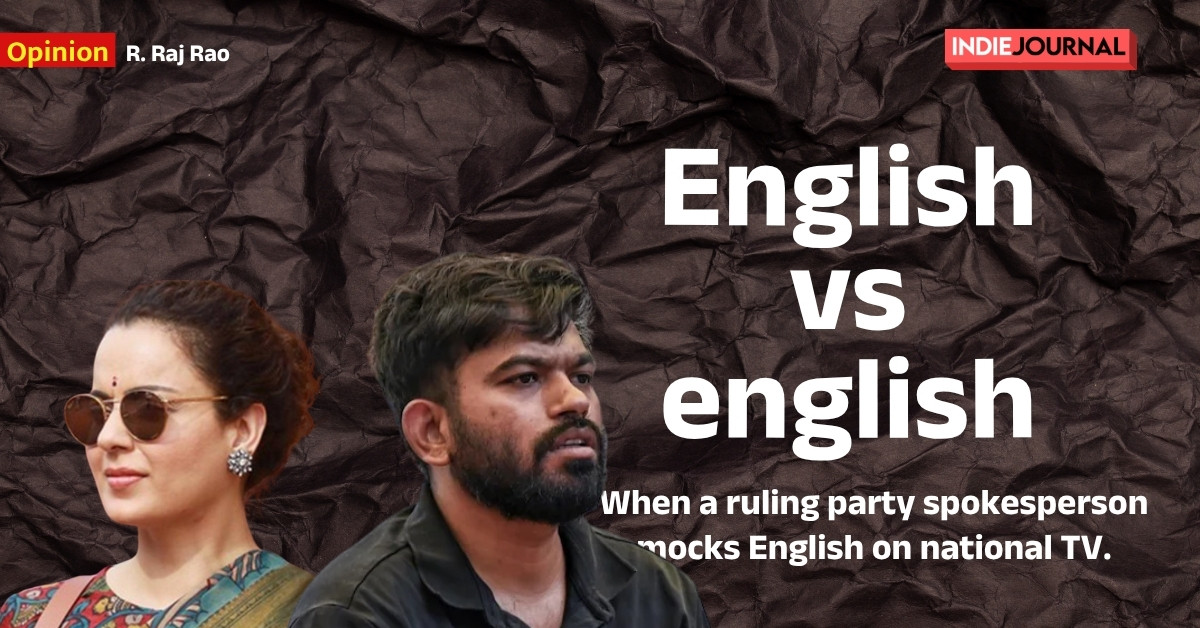
A spokesperson of the ruling party, now popularised by the ominous words ‘regime change,’ recently mocked CJP founder Abhijeet Dipke’s English pronunciation on national television. She parodied the way he pronounced the word ‘pressure’ as ‘praishure’ when he said, as he was ‘abducted’ from the plane in Delhi, that PM Modi and Amit Shah should “keep checking their blood pressure.”
The news anchor looked the other way as the spokesperson spoke. She pretended not to have heard. But she couldn’t not have heard, as the spokesperson in question is famous for her obstreperousness - one has often to put on ear-plugs as she rants. As for the news anchor, letting the slur pass instead of pulling up the spokesperson, famous for her personal swipes, made her complicit. Ironically, the news channel where the mimicry played out had once employed the legendary Ravish Kumar, who patented the phrase ‘godi media.’ Not surprising, given that, as a viral video posted by MNS founder Raj Thackeray shows, the channel is owned by one of Modi’s bosom pals, Gautam Adani. Still, can one imagine a white news anchor sniggering at a coloured person’s accent or pronunciation on American television?
Convent-educated Indians who think of themselves as the cat’s whiskers should ask if they employ stress and intonation, or plosives and diphthongs, in their speech.
Making fun of someone’s pronunciation, especially in English, a language associated with caste and class privilege, can be construed as an act of humiliation, if the person thus ridiculed is from a caste protected by the Scheduled Castes and Scheduled Tribes (Prevention of Atrocities) Act, 1989. In the very same news bulletin in which she ridiculed Dipke, the spokesperson self-referentially emphasised that she lived in Mumbai’s Malabar Hill, one of India’s most affluent neighbourhoods.
The larger question, however, is whether non-native speakers of English, that include the offending spokesperson, can afford to be holier-than-thou? The gold standard of spoken English is RS-English or Received Standard English, which, even in England, is spoken only in the south-east of the country. It’s the sort of English BBC news broadcasters are trained to speak. Convent-educated Indians who think of themselves as the cat’s whiskers should ask if they employ stress and intonation, or plosives and diphthongs, in their speech. Or, whether they even know what plosives and diphthongs are. And if they don’t, then the difference between them and the Dipkes of the world is merely one of degree and not of kind.
The fact is, in the 21st century, pooh-poohing anyone’s English only betrays how antiquated we are. It proves that while colonialism ended almost eighty years ago, we aren’t at all decolonised as yet.
To allow the language to be defined by the way people speak it is descriptive.
In their book 'The Empire Writes Back', Bill Ashcroft, Gareth Griffiths and Helen Tiffin write: “One of the main features of imperial oppression is control over language. The imperial education system installs a ‘standard’ version of the metropolitan language as the norm, and marginalises all ‘variants’ as impurities.”
The three authors stress the need to “distinguish…between the ‘standard’ British English inherited from the empire and the english [in the lower case] which the language has become in post-colonial countries.”
To insist that we speak in standard English is prescriptive. Whereas, to allow the language to be defined by the way people speak it is descriptive. Today, prescriptive English has been replaced by descriptive English all over the world.
This discussion becomes all the more relevant in India in the context of what Prime Minister Modi has called a “Macaulay mindset.” It presumably applies to Indians who, to quote the poet Kamala Das, speak, write and dream in English. Modi speaks of eradicating the Macaulay mindset by 2035, two hundred years after Thomas Babbington Macaulay presented his Minute on Education to Governor General Lord William Bentinck, which made English the medium of instruction in Indian schools. In Macaulay’s ponderous words, “A single shelf of a good European library was worth the whole native literature of India and Arabia.”
The mother tongue has a way of interfering in the way we pronounce English words.
Taking his cue from his leader, Amit Shah went a step further. He claimed that those who clung to English beyond 2035 would soon feel “ashamed” of themselves.
Modi cannot dispense with the Macaulay mindset, however, if one of his own party’s spokespersons does not know that how we speak English depends on where we are born, to what school we have been sent and what our mother tongue is. The mother tongue has a way of interfering in the way we pronounce English words. Modi himself, as his late night reels to Gen Z shows, pronounces the word ‘friends’ as ‘frands’. To use this to slight someone, even if they are our political opponents, is immoral. While Amit Shah speaks of the continuing use of English as enough to shame Indians, here is his party’s spokesperson who does the exact opposite. Imagining herself to be the Queen, she shames Indians like Abhijeet Dipke for not speaking what she regards as propah English.